

For many Americans, the U.S. Constitution is both familiar and mysterious. Most people recognize terms such as "checks and balances," "separation of powers," "judicial review," and "due process," yet few have had the opportunity to study how these principles actually work in practice.
The challenge is not a lack of interest. It's accessibility. Constitutional law textbooks can be dense, legal terminology can feel intimidating, and many online discussions quickly become partisan rather than educational.
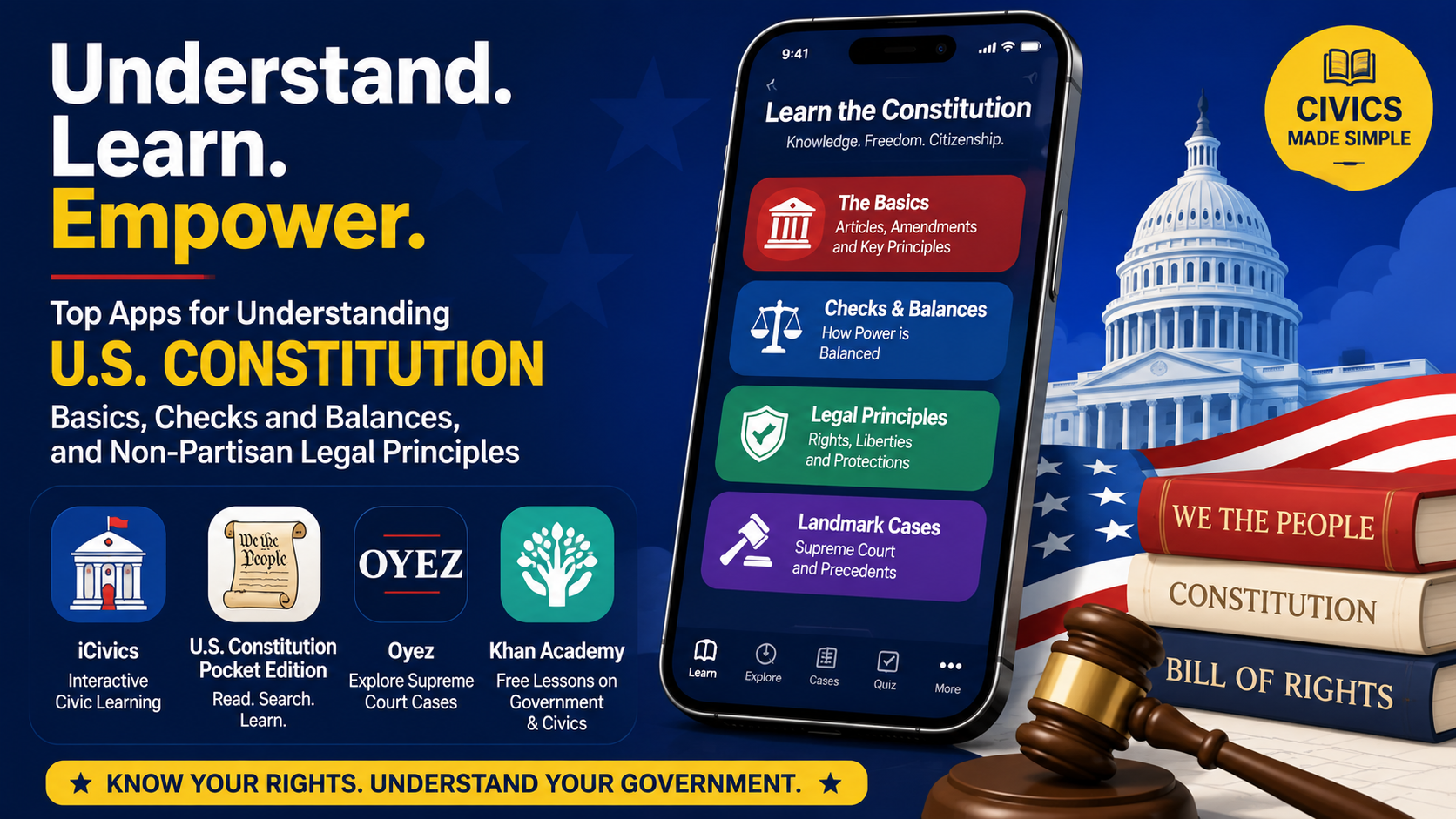
To find the strongest mobile apps for learning constitutional fundamentals, we spent several weeks testing educational and civic-learning apps available on the Apple App Store and Google Play. The goal was not to find legal advice tools or political advocacy platforms. Instead, we focused on apps that help users understand constitutional structure, the three branches of government, checks and balances, landmark legal principles, and foundational civic knowledge.
Our testing evaluated three key areas:
Accuracy and educational value.
Clarity of constitutional explanations.
Accessibility for non-lawyers.
After extensive testing, four apps consistently delivered meaningful educational value.
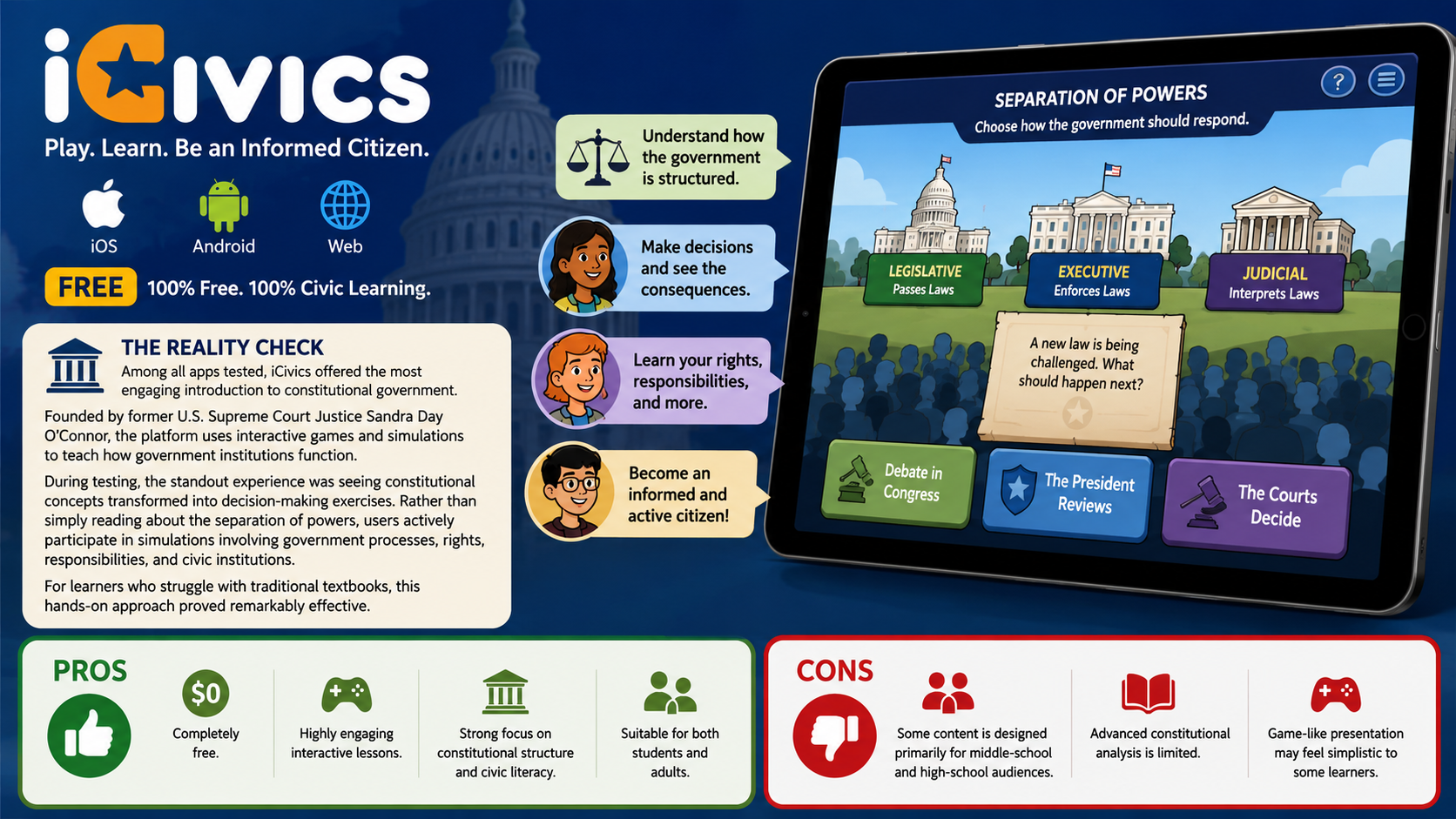
Availability: iOS, Android, Web
Pricing Model: Free.
Among all apps tested, iCivics offered the most engaging introduction to constitutional government.
Founded by former U.S. Supreme Court Justice Sandra Day O'Connor, the platform uses interactive games and simulations to teach how government institutions function.
During testing, the standout experience was seeing constitutional concepts transformed into decision-making exercises. Rather than simply reading about the separation of powers, users actively participate in simulations involving government processes, rights, responsibilities, and civic institutions.
For learners who struggle with traditional textbooks, this hands-on approach proved remarkably effective.
Completely free.
Highly engaging interactive lessons.
Strong focus on constitutional structure and civic literacy.
Suitable for both students and adults.
Some content is designed primarily for middle-school and high-school audiences.
Advanced constitutional analysis is limited.
Game-like presentation may feel simplistic to some learners.
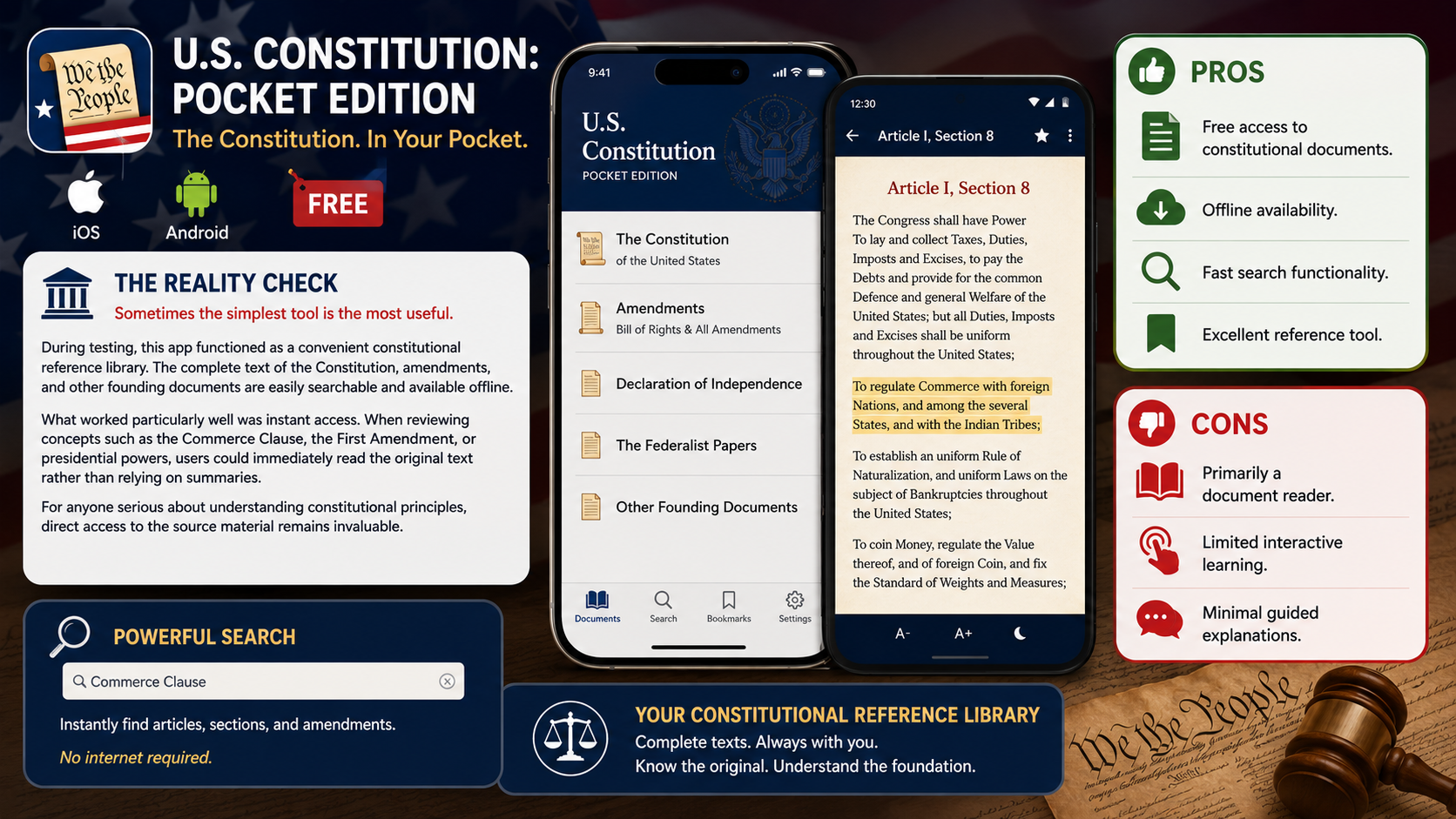
Pricing Model: Free.
Sometimes the simplest tool is the most useful.
During testing, this app functioned as a convenient constitutional reference library. The complete text of the Constitution, amendments, and other founding documents are easily searchable and available offline.
What worked particularly well was instant access. When reviewing concepts such as the Commerce Clause, the First Amendment, or presidential powers, users could immediately read the original text rather than relying on summaries.
For anyone serious about understanding constitutional principles, direct access to the source material remains invaluable.
Free access to constitutional documents.
Offline availability.
Fast search functionality.
Excellent reference tool.
Primarily a document reader.
Limited interactive learning.
Minimal guided explanations.
Availability: iOS
Pricing Model: Free.
Constitutional principles often become clearer when viewed through real court cases.
That's where Oyez excels.
Developed as an educational project focused on the U.S. Supreme Court, Oyez provides access to case summaries, justice biographies, and audio recordings of oral arguments.
When testing the app, listening to actual Supreme Court arguments added context that textbooks rarely provide. Concepts such as freedom of speech, equal protection, due process, and federalism become far easier to understand when users see how courts apply them in practice.
For learners interested in constitutional interpretation, Oyez delivered the deepest educational value of any app reviewed.
Free access to Supreme Court educational resources.
Real oral argument recordings.
Excellent case summaries.
Strong historical context.
iOS only.
Less beginner-friendly than other apps.
Focused primarily on judicial interpretation.
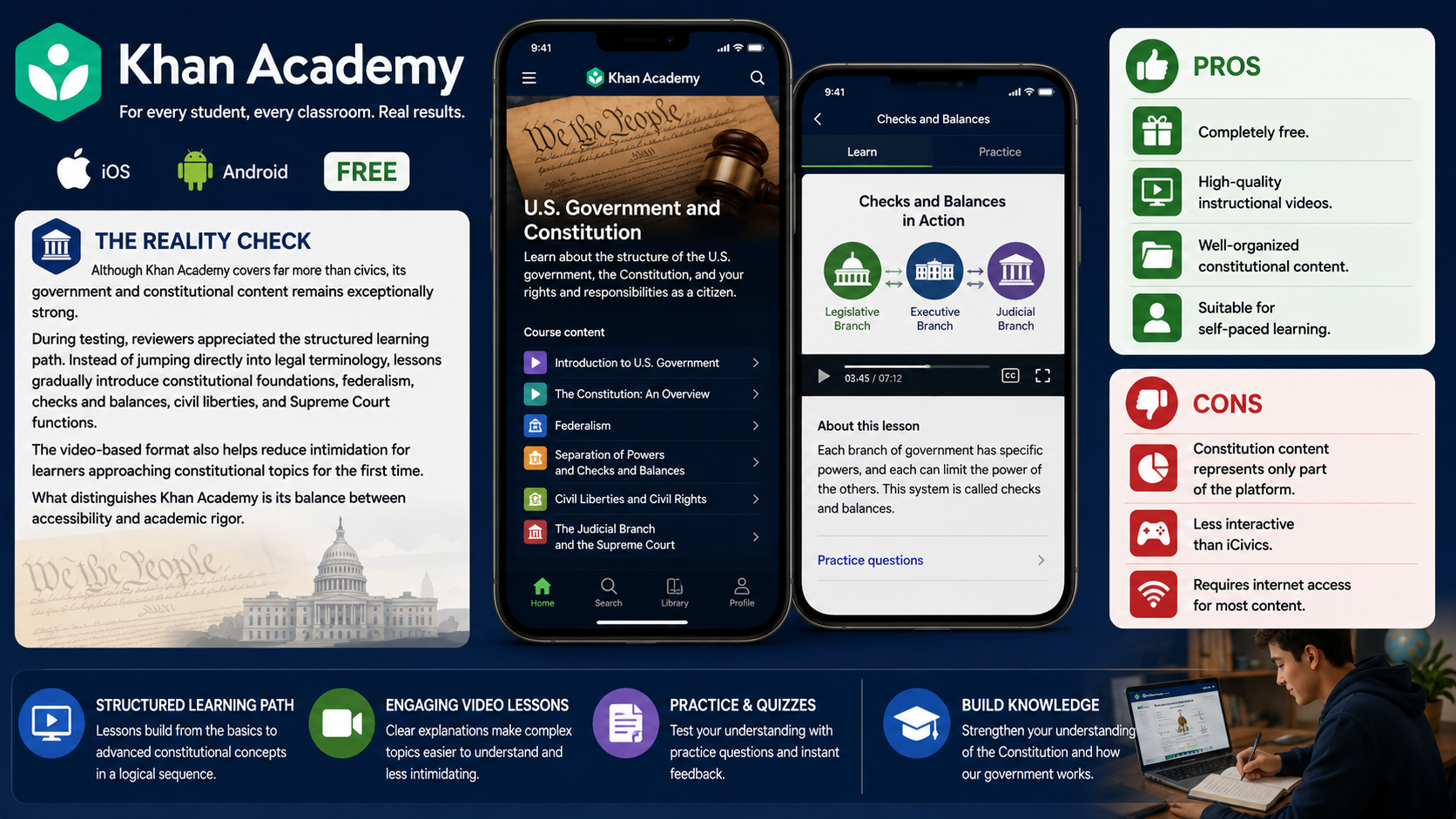
Pricing Model: Free.
Although Khan Academy covers far more than civics, its government and constitutional content remains exceptionally strong.
During testing, reviewers appreciated the structured learning path. Instead of jumping directly into legal terminology, lessons gradually introduce constitutional foundations, federalism, checks and balances, civil liberties, and Supreme Court functions.
The video-based format also helps reduce intimidation for learners approaching constitutional topics for the first time.
What distinguishes Khan Academy is its balance between accessibility and academic rigor.
Completely free.
High-quality instructional videos.
Well-organized constitutional content.
Suitable for self-paced learning.
Constitution content represents only part of the platform.
Less interactive than iCivics.
Requires internet access for most content.
The ideal constitutional learning app depends on the learner's goals.
For beginners seeking the most engaging introduction to checks and balances, separation of powers, and civic institutions, iCivics stands out as the strongest overall choice. Its interactive approach transforms abstract constitutional concepts into experiences that users can actively explore.
For users who want direct access to primary sources, U.S. Constitution: Pocket Edition remains an essential companion. Nothing replaces reading the actual constitutional text.
Meanwhile, Oyez offers the most valuable window into how constitutional principles are interpreted by the Supreme Court, making it particularly useful for learners who want deeper context. And for those who prefer structured courses and video instruction, Khan Academy provides one of the most approachable educational experiences available.
After weeks of testing, one conclusion became clear: learning constitutional fundamentals no longer requires a university course or a shelf full of legal textbooks. The strongest mobile apps now make it possible to explore the foundations of American government, checks and balances, and non-partisan legal principles from virtually anywhere—all while keeping the focus on education rather than political debate.