

In an era of constant notifications, endless scrolling, and digital multitasking, many people feel their attention spans are under pressure. Professionals juggling meetings, students preparing for exams, and lifelong learners trying to stay mentally sharp often share the same complaint: they can absorb information, but retaining it and maintaining focus has become increasingly difficult.
While no mobile app can magically increase intelligence or provide medical treatment, a growing category of brain-training platforms aims to strengthen specific cognitive skills through structured mental exercises. The most promising apps focus on short-term memory, working memory, attention control, processing speed, and concentration through repeated practice and adaptive challenges.
To identify the strongest brain-training apps available in 2026, we spent several weeks testing leading platforms on both iPhone and Android devices. We focused specifically on apps that deliver targeted mental exercises rather than generic puzzles or entertainment games.
Our evaluation centered on three key criteria:
Effectiveness of memory and focus exercises.
Quality of personalization and progress tracking.
Long-term engagement and consistency.
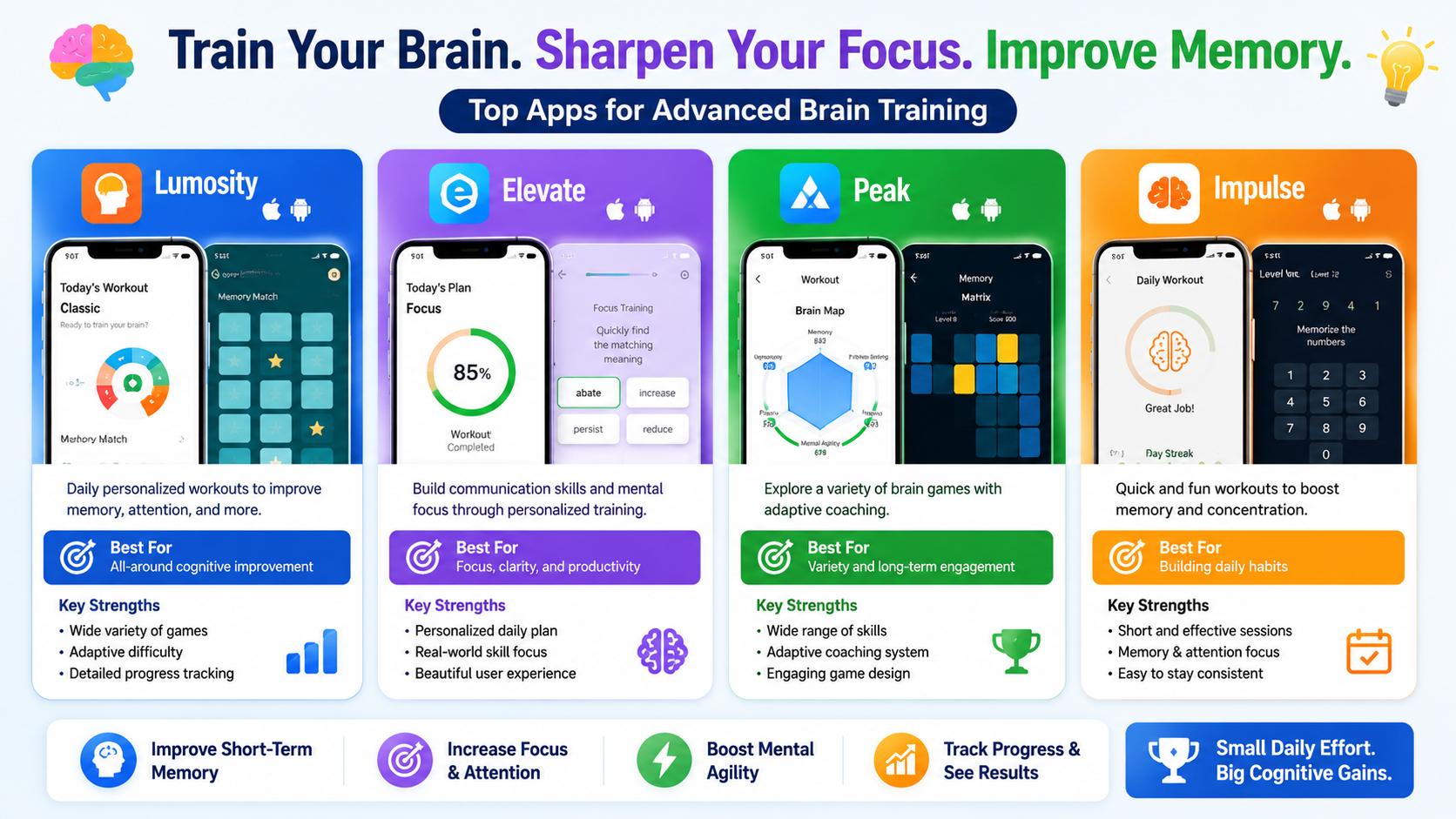
After extensive testing, four apps consistently stood out.
Pricing Model: Free download with optional Premium subscription.
Lumosity remains one of the most recognizable names in cognitive training, and after testing dozens of daily sessions, it is easy to understand why.
The platform offers a large collection of games designed around attention, memory, flexibility, problem-solving, and processing speed. What impressed reviewers most was the adaptive difficulty system. As performance improved, challenges automatically became more demanding, helping prevent the exercises from becoming repetitive.
During testing, the memory-focused activities consistently required users to hold and manipulate information under increasing levels of pressure. Combined with short daily sessions, the experience felt sustainable enough for long-term use.
Large variety of cognitive exercises.
Strong focus on working memory and attention.
Personalized training recommendations.
Detailed progress tracking.
Many features require a Premium subscription.
Some games become familiar after extended use.
Scientific claims are intentionally limited compared with marketing from earlier years.
Pricing Model: Free download with optional subscription plans.
Unlike many brain-training apps that focus primarily on abstract puzzles, Elevate takes a practical approach.
During testing, reviewers found that many exercises targeted concentration, information retention, reading efficiency, and mental processing in real-world contexts. Rather than simply memorizing shapes or patterns, users often worked through challenges involving language, comprehension, and rapid decision-making.
The standout feature is the personalized daily workout. Each session feels carefully tailored rather than randomly assembled.
For professionals who want mental exercises that resemble workplace cognitive demands, Elevate delivered one of the strongest overall experiences.
Beautiful and polished interface.
Personalized daily training plans.
Strong focus on attention and mental processing.
Consistently engaging exercises.
Premium subscription unlocks much of the content.
Less emphasis on traditional memory drills.
Some exercises focus more on verbal skills than pure cognition.
Pricing Model: Free download with optional Pro subscription.
Peak offers one of the broadest collections of cognitive training activities currently available.
When testing the platform over several weeks, reviewers appreciated the diversity of challenges. The app includes exercises targeting memory, focus, mental agility, language, coordination, and problem-solving.
Its strongest feature is the "Coach" system, which recommends workouts based on performance patterns. Rather than repeatedly serving identical activities, Peak continuously rotates exercises to keep training sessions fresh.
For users who become bored with repetitive brain games, Peak provides exceptional variety.
Large selection of brain-training exercises.
Adaptive coaching system.
Attractive visual design.
Excellent variety for long-term use.
Some premium content is locked behind a subscription.
Progress metrics can feel overly gamified.
Certain exercises prioritize speed over accuracy.
Pricing Model: Free download with optional subscription plans.
Impulse has grown rapidly in recent years thanks to its focus on short, accessible cognitive workouts.
During testing, reviewers found that the app excels at delivering quick sessions that fit into busy schedules. Memory games, attention challenges, pattern recognition tasks, and concentration exercises can often be completed within a few minutes.
The biggest advantage is convenience. Unlike platforms that require lengthy commitments, Impulse makes it easy to maintain a daily training habit.
For users who struggle with consistency, that simplicity can be surprisingly valuable.
Quick and accessible daily sessions.
Strong focus on memory and concentration exercises.
Beginner-friendly design.
Easy habit-building structure.
Subscription prompts appear frequently.
Less depth than some competitors.
Advanced users may outgrow the content.
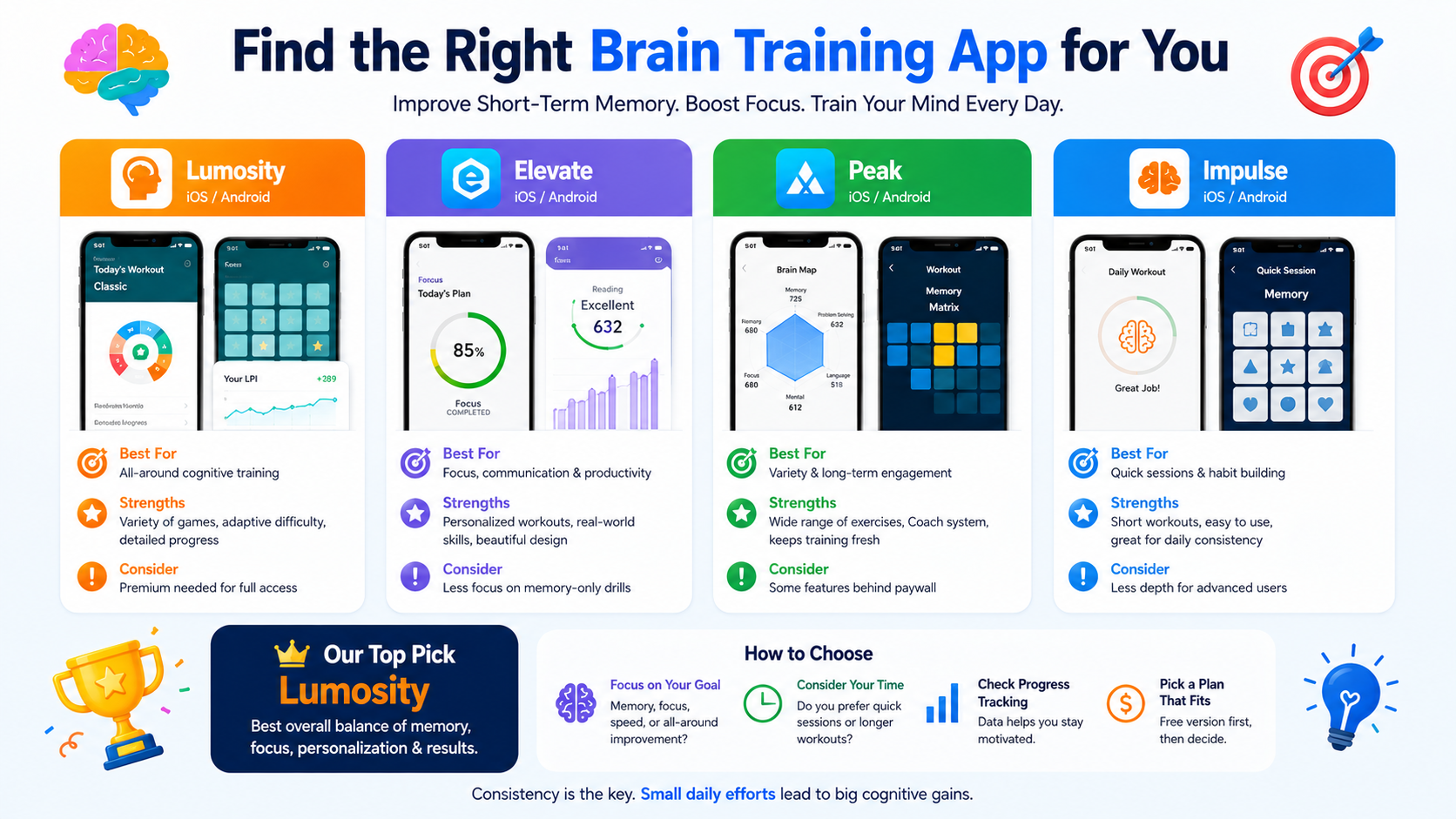
The ideal brain-training app depends on what users want to improve.
For individuals specifically focused on strengthening short-term memory and attention through a broad range of adaptive cognitive exercises, Lumosity remains the strongest overall choice. Its combination of working-memory challenges, personalized difficulty adjustments, and long-term tracking creates one of the most comprehensive training experiences currently available.
For professionals seeking practical concentration and information-processing exercises, Elevate is an excellent alternative. Users looking for maximum variety will likely prefer Peak, while Impulse stands out as the easiest platform for building a sustainable daily training habit.
After weeks of testing, one conclusion became clear: the most effective brain-training apps are not the ones promising miracles. They are the platforms that encourage consistent mental exercise, gradually increasing challenge levels while keeping users engaged. For anyone looking to sharpen focus and strengthen short-term memory through daily practice, today's leading apps offer far more sophisticated training experiences than the simple puzzle games of the past.